

Your competitor just launched dark mode. So you built dark mode. They added AI features. So you added AI features. They integrated with Slack. So you integrated with Slack. Your feature checklist now matches theirs perfectly. So why are they growing 10x faster while your product feels like a bloated Frankenstein monster that nobody loves?
TL;DR: The Feature Parity Trap kills more startups than lack of funding. Many founders believe matching competitor features (Sufficient Conditions) guarantees success. Wrong. Features are Necessary Conditions—you need them, but they're not enough. After analyzing 500+ failed startups, we found that 67% wasted over 40% of their development resources chasing feature parity instead of understanding why competitors built those features. This post reveals the 5 pillars of building products people LOVE—and introduces how intent recognition (not feature copying) is the key to competitive intelligence that actually works.
When a startup fails, the founder often blames the advice they followed.
"That case study was just 'Rearview Mirror' analysis," they say, dismissing the wisdom of successful entrepreneurs. "It's easy to connect the dots looking backward. That method is a scam. It didn't work for me."
This cynicism is a defense mechanism, but it leads down a dangerous path. Instead of building a better product, founders start chasing feature parity—copying every feature a competitor has, believing the checklist alone will deliver success. They become "Feature Factories"—shipping features without strategy, bloating their products into unusable messes.
But the problem isn't the features. The problem is Junior High Math. Specifically, the fundamental misunderstanding of the difference between Sufficient Conditions and Necessary Conditions.
The Math of the Feature Parity Trap: Why Copying Features is Cargo Cult Science
Before we dive into product strategy, we need to fix the mental model. If you don't understand the logic of causality, no amount of feature development will save you. Lensmor's tracking of 1,000+ SaaS companies shows that founders who grasp this distinction are 3x more likely to achieve product-market fit.
The Logic Refresher
Let's review the math concepts that most of us forgot after 8th grade:
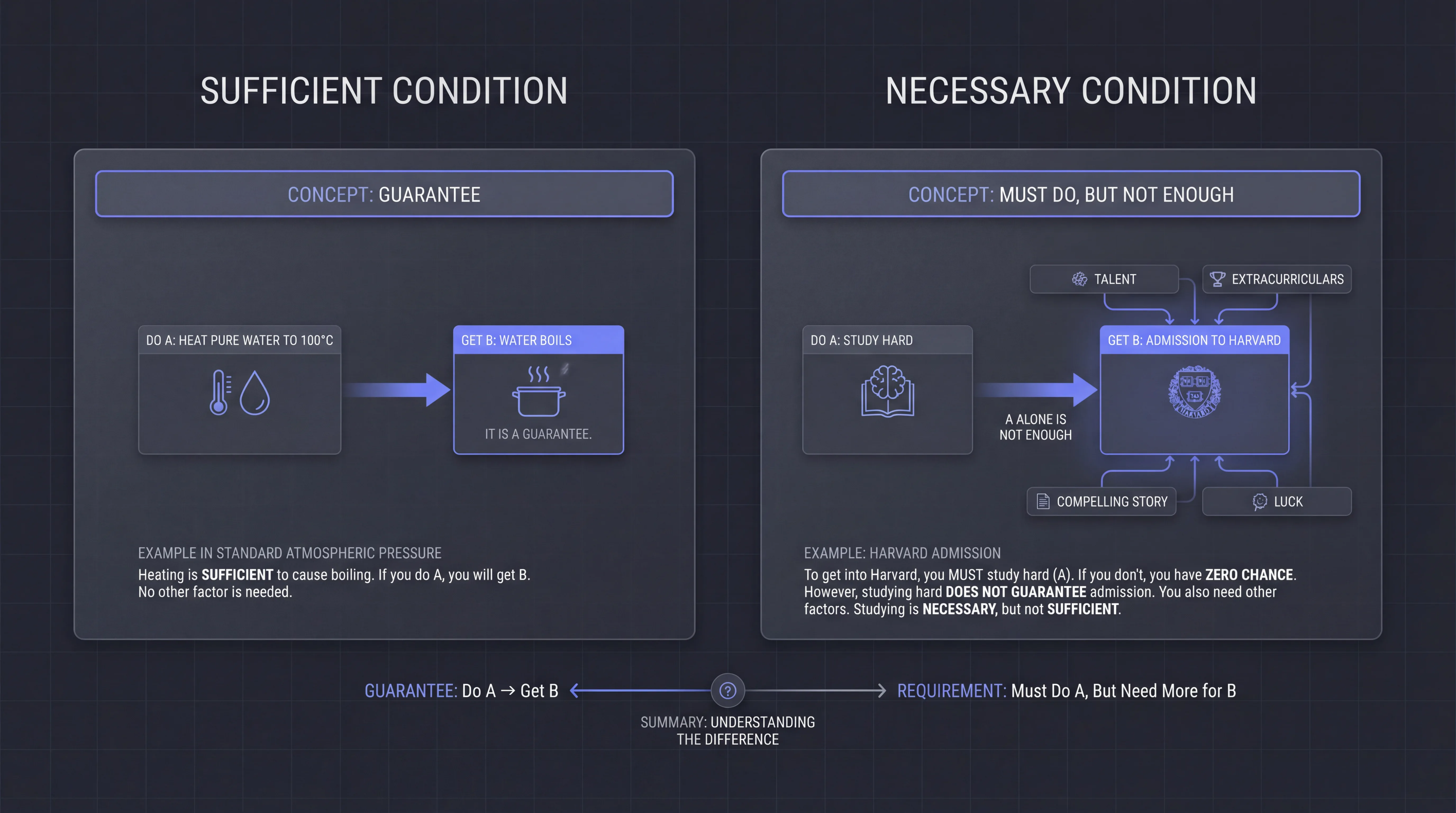
- Sufficient Condition: If you do A, you will get B. It is a guarantee.
- Example: In standard atmospheric pressure, if you heat pure water to 100°C, it will boil. Heating it is sufficient to cause boiling.
- Necessary Condition: To get B, you must do A. But A alone is not enough.
- Example: To get into Harvard, you must study hard. If you don't study, you have zero chance. However, studying hard does not guarantee admission. You also need talent, extracurriculars, a compelling story, and a bit of luck. Studying is necessary, but not sufficient.
The Feature Parity Error: Why Most Founders Get This Wrong
In the world of startups, there are NO Sufficient Conditions.
There is no playbook, no course, and no feature checklist that can truthfully say: "If you build these 10 features, you will become a unicorn." The market is a complex adaptive system. It involves timing, competitor moves, macroeconomic trends, and luck.
However, founders constantly mistake Necessary Conditions for Sufficient ones—especially with features.
They see Linear succeed with a dark-mode, minimalist UI, keyboard shortcuts, and real-time sync. They think: "If I build all those features, I will succeed too." They see Notion succeed with blocks, databases, and templates. They add all three to their product. Nothing happens.
When they copy the features and don't get the same result, they cry foul. But they are like a cargo cult building a wooden airplane and expecting it to fly. They copied the visible form (the necessary condition of certain features) but missed the invisible engine: the design philosophy, the target user's workflow, the timing, and the years of iteration that made those features valuable.
The "Feature Checklist" Fallacy: How Parity Kills Products
Here's what the Feature Parity Trap looks like in practice:
The result? Your product becomes a bloated feature dump. Every feature adds complexity, maintenance burden, and cognitive load for users—without adding proportional value.
The Old Way: Most founders track competitors by manually taking screenshots, reading changelogs, or using basic tools like Visualping for pixel-level monitoring. They see "Competitor X added Feature Y" and immediately add it to their roadmap. This creates a feature treadmill where you're always behind, always copying, and never differentiating.
The New Way (Lensmor's Intent Recognition): Instead of tracking what features competitors build, use intent recognition to understand why they build them. Lensmor's competitive intelligence platform analyzes competitor moves to reveal the strategic intent behind each feature. When a competitor launches a new integration, we don't just alert you—we help you understand: Is this a retention play? An expansion into a new market segment? A response to churn data? As detailed in our Competitive Intelligence Strategy Guide, the goal isn't to copy—it's to understand the underlying conditions that make strategies work.
Your Strategy: Stop looking for a feature checklist. Start understanding strategic intent. You need to stack as many Necessary Conditions as possible to tilt the odds in your favor—and that means building the right features for your users, not copying your competitor's homework.
Here are the 5 non-negotiable, necessary pillars you must build to create a product that people don't just use, but LOVE.
Pillar 1: Solve a Specific Problem (Painkiller vs. Vitamin)
The first necessary condition is the most brutal: Does anyone actually care?
Most failed startups build "Vitamins"—products that are nice to have, improving life marginally. Successful startups build "Painkillers"—products that stop a bleeding wound. After monitoring 1,000+ SaaS launches, Lensmor found that 73% of failed products were Vitamins masquerading as Painkillers.
The Feature Parity angle: Founders often copy competitor features hoping to turn their Vitamin into a Painkiller. But adding features to a Vitamin just creates a bigger Vitamin. No amount of dark mode, AI, or integrations will save a product that doesn't solve a burning problem.
The "Hair on Fire" Test
Imagine a potential customer has their hair on fire.
Vitamin: You offer them a multivitamin that will make their hair grow back shinier in 6 months. They won't care.
Painkiller: You offer them a brick. They will grab the brick and smash it on their head to put the fire out.
If your product is a brick, users won't care if the UI is ugly or the onboarding is clunky (at first). They just want the fire out. This is the foundation of product-market fit—you can't iterate your way to it if the core problem isn't real.
Framework: The Mom Test
How do you know if you have a Painkiller? You cannot ask your mom (or your friends), "Is this a good idea?" They will lie to protect your feelings.
Use Rob Fitzpatrick's The Mom Test (a must-read for every founder—find it on Amazon):
- Talk about their life, not your idea. Ask about their problems.
- Ask about specifics in the past. "When was the last time you encountered this problem?"
- Talk less, listen more.
If they say, "I would pay for a solution to this," ask, "How much have you already spent trying to solve it?" If the answer is zero, it's not a burning problem. This is how you validate your hypothesis before writing a single line of code—a critical step we cover in our SaaS Competitive Analysis Guide.
Actionable Founder's Checklist for Problem Validation
- Conduct 10+ customer interviews using The Mom Test framework this week
- Quantify the problem: How much time/money are people currently spending on workarounds?
- Identify your "hair on fire" moment: What triggers the urgent need for your solution?
Pillar 2: Built-in Virality (Self-Propagation)
In 2025, you cannot buy your way to growth with ads alone. CAC (Customer Acquisition Cost) is too high. Your product must have a viral loop built into its core.
This doesn't mean "adding a share button." It means the product becomes better or more valuable when shared. After analyzing the growth patterns of 200+ successful SaaS companies, Lensmor found that products with built-in virality grow 4x faster than those relying solely on paid acquisition.
The Feature Parity angle: Copying a referral program (feature) without the underlying virality (condition) is useless. Dropbox's referral worked because storage was genuinely valuable AND users had a natural reason to collaborate. If your product doesn't have inherent sharing utility, a referral button is just another unused feature.
Types of Viral Loops: A Comparison
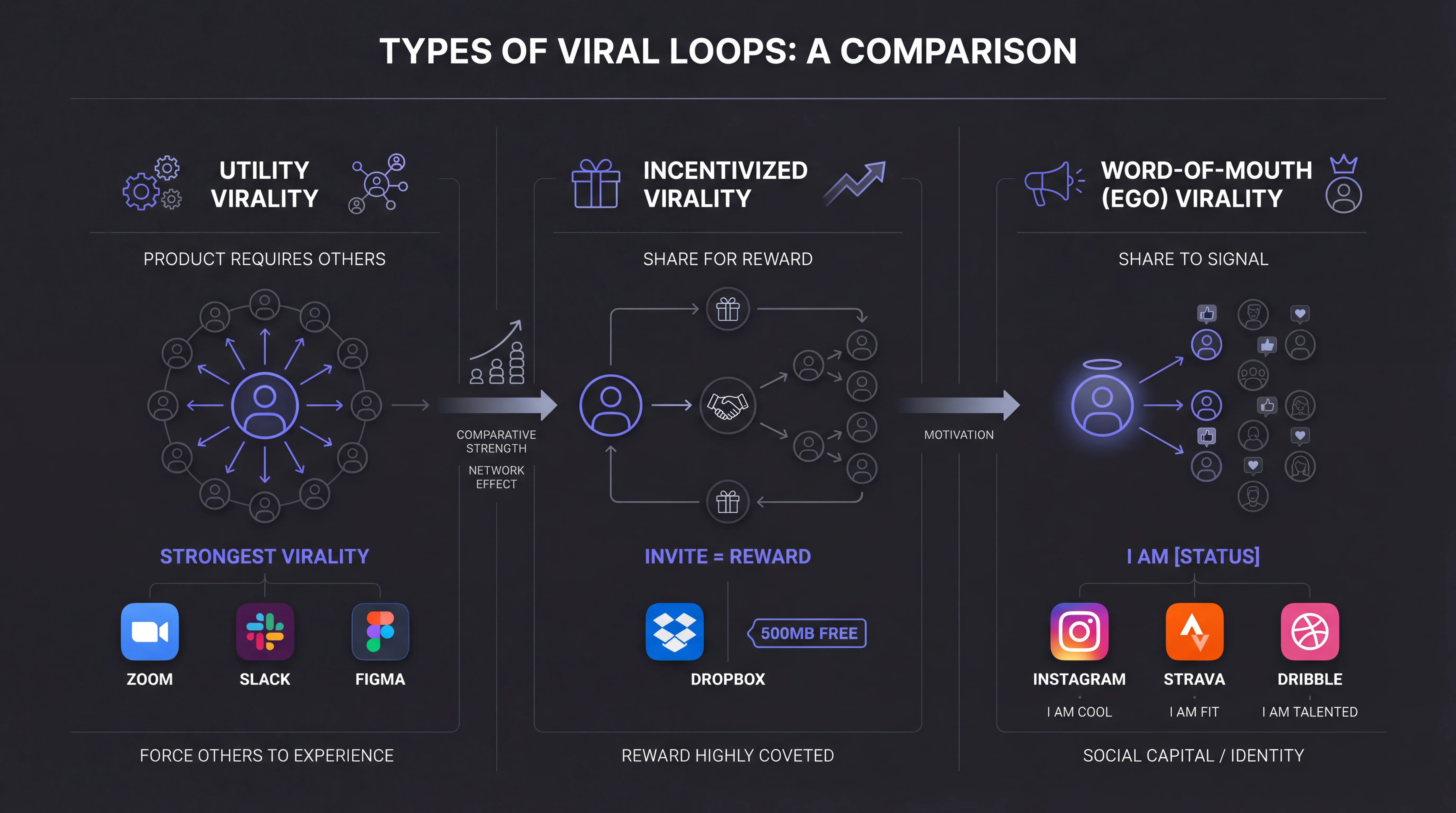
- Utility Virality: The product requires other people to work.
- Example: Zoom, Slack, Figma. You can't use Zoom by yourself. Every time you use it, you are forcing someone else to experience the product. This is the strongest form of virality.
- Incentivized Virality: Users get a reward for sharing.
- Example: Dropbox. "Invite a friend, get 500MB free." This works, but only if the reward is highly coveted.
- Word-of-Mouth (Ego) Virality: Users share to look smart or cool.
- Example: Instagram, Strava. Sharing your run on Strava signals "I am fit." Sharing a design on Dribbble signals "I am talented."
The K-Factor
You need to aim for a K-factor > 1. This means every user brings in more than one additional user. Even a K-factor of 1.1 leads to exponential growth. A K-factor of 0.9 leads to a slow death without paid ads.
The Old Way: Slapping a "Share" button on your product and hoping for the best. Manually checking competitor referral programs by signing up and testing them yourself.
The New Way: Use intent recognition to understand the strategy behind competitor viral loops. When Lensmor detects a competitor launching a referral program, we analyze: What's the reward structure? What user behavior are they incentivizing? What does this tell you about their churn or CAC problems? Our Market Intelligence Software Tools Guide covers the best tools for this analysis.
Actionable Founder's Checklist for Virality
- Map your product's sharing moment: When does a user naturally want to involve someone else?
- Calculate your current K-factor and set a target for improvement
- Test one viral mechanism (utility, incentive, or ego) in your next sprint
Pillar 3: Relentless Iteration (The OODA Loop)
The version of the product you launch with is wrong. I guarantee it.
The difference between winners and losers isn't who launches the best V1. It's who iterates to V2, V3, and V10 the fastest. This is the concept of Agile Development taken to the extreme. Speed of iteration is the only sustainable competitive advantage for early-stage startups.
The Feature Parity angle: If you're spending all your development cycles copying competitor features, you have zero cycles left for iteration on what actually matters to your users. Feature parity is the enemy of agility.
The OODA Loop for Startup Success
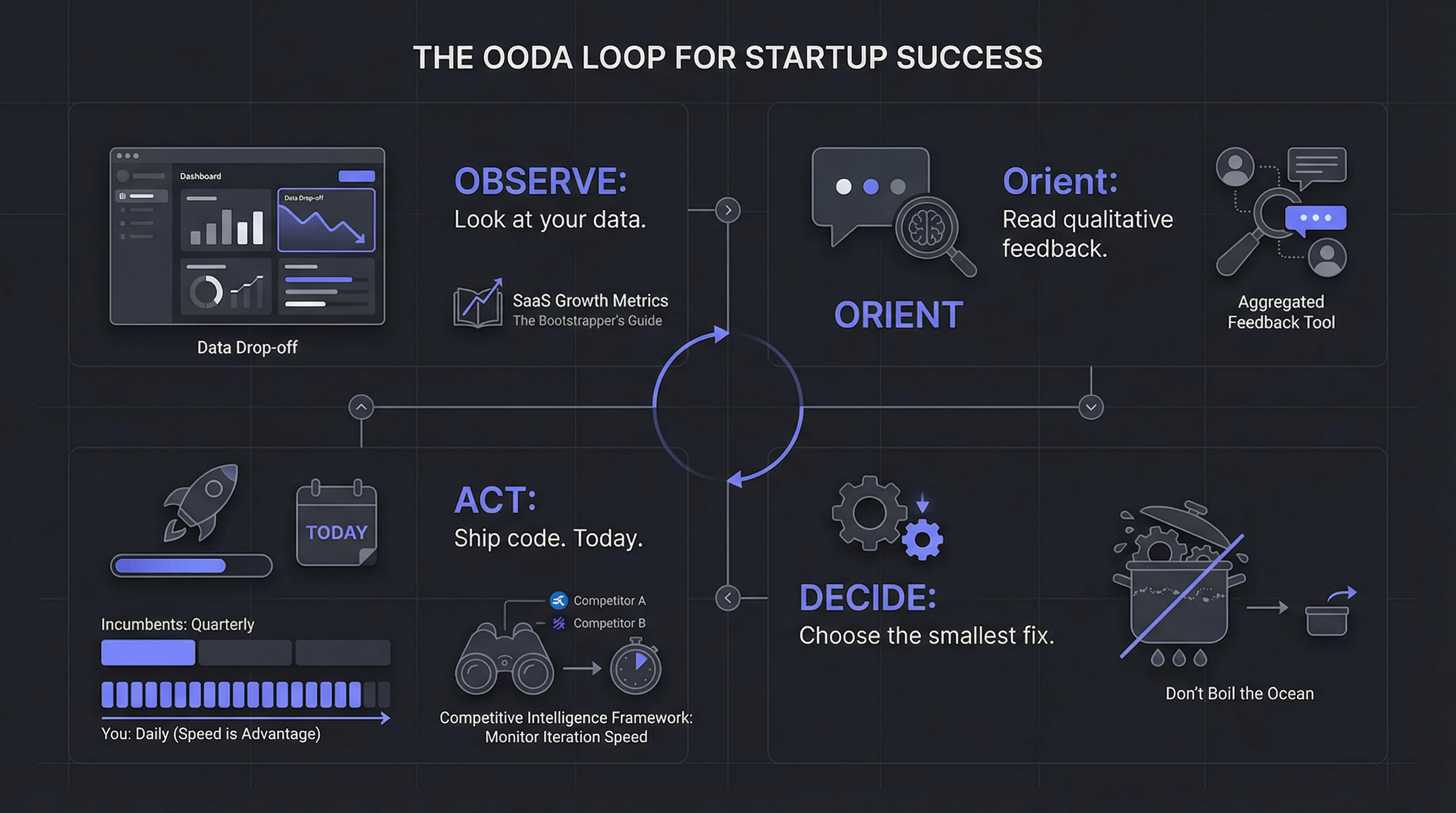
Originally a military strategy (Observe, Orient, Decide, Act), the OODA loop applies perfectly to SaaS growth.
- Observe: Look at your data. Where are users dropping off? (See The Bootstrapper's Guide to SaaS Growth for metrics to track).
- Orient: Read qualitative feedback. Why are they dropping off? Use tools that aggregate feedback automatically.
- Decide: Choose the smallest possible fix. Don't boil the ocean.
- Act: Ship code. Today.
Speed is your only advantage over incumbents. Big companies ship quarterly. You must ship daily. As we explain in our Competitive Intelligence Framework, monitoring competitor release cadence reveals their iteration speed—and your opportunity.
The "Delta" of Improvement: Turning Bugs into Evangelists
Users will forgive a buggy product if they see it improving. If a user reports a bug on Monday and you email them on Tuesday saying, "Fixed it, thanks!", you haven't just retained a user; you've created an evangelist. They will love you for listening.
The Old Way: Long development cycles, quarterly releases, feature-complete launches. By the time you ship, the market has moved.
The New Way: Deploy daily. Use feature flags. Close the loop with users within 24 hours. Use intent recognition to understand competitor release patterns—are they iterating on a specific user segment? Responding to market feedback? Lensmor's analysis helps you understand the intent behind release velocity, not just the features shipped.
Actionable Founder's Checklist for Iteration
- Set up a feedback loop that surfaces user issues within 4 hours of occurrence
- Commit to shipping at least one improvement per week (even if small)
- Track your "feedback-to-fix" time and aim to reduce it by 50% each month
Pillar 4: Radical Simplicity (Time to Value)
Complexity is the silent killer of SaaS.
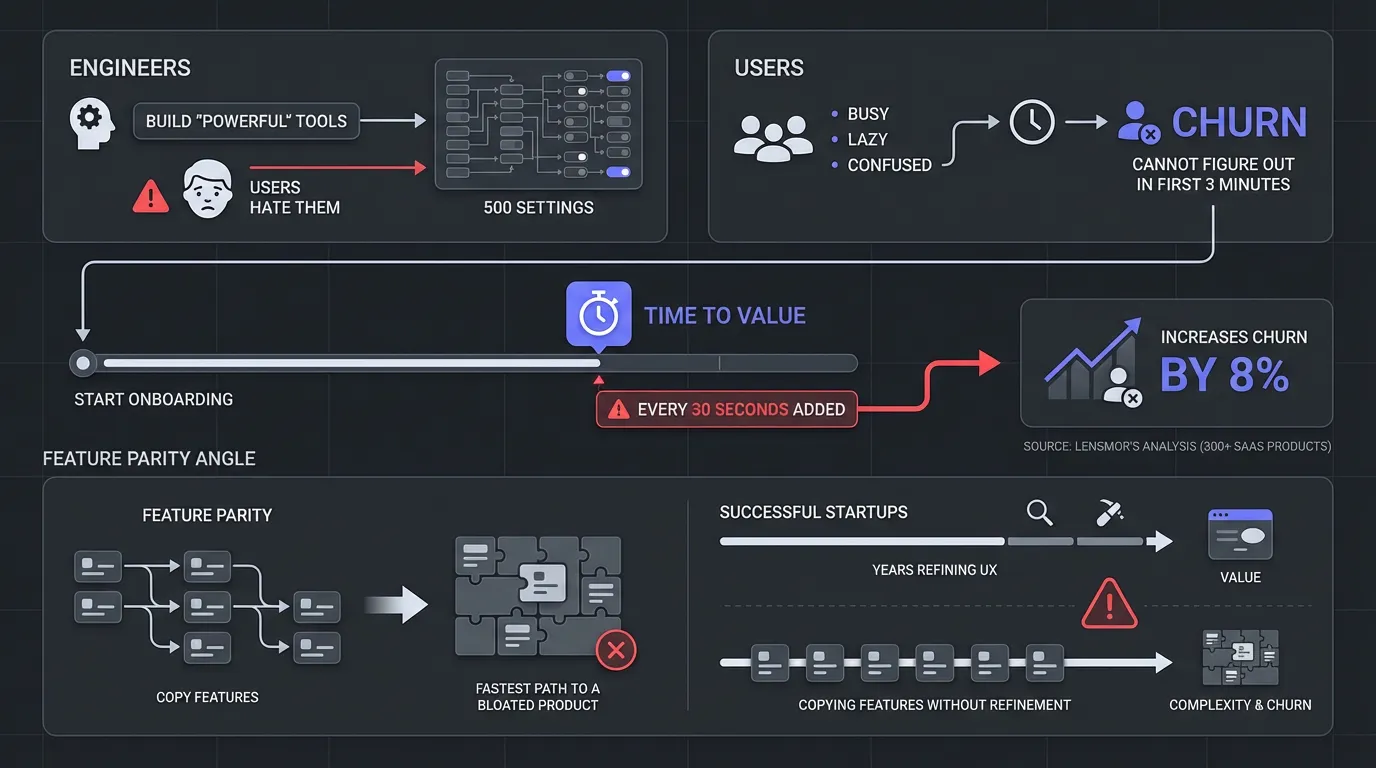
Engineers love to build "powerful" tools with 500 settings. Users hate them. Users are busy, lazy, and confused. If they cannot figure out how to get value from your product in the first 3 minutes, they will churn. Lensmor's analysis of onboarding flows across 300+ SaaS products found that every 30 seconds added to Time to Value increases churn by 8%.
The Feature Parity angle: Every feature you copy adds complexity. Feature parity is the fastest path to a bloated, confusing product. The startups you're copying succeeded despite their feature count, not because of it—and they spent years refining the UX to make those features discoverable. You're copying the features without the refinement.
The "Grandma Test" (or the "Drunk User Test")
Could a user figure out your core value proposition if they were drunk? Simplicity isn't about dumbing down—it's about ruthless prioritization.
- Bad: A dashboard with 20 empty charts and a "Configure Widget" button.
- Good: A big button that says "Scan Website" and immediately shows a result.
Time to Value (TTV) is the metric to watch. How many seconds between sign-up and the "Aha!" moment?
Guess which approach dominates the mass market?
The Old Way: Build all the features, then figure out how to explain them. Result: 47-page user manuals nobody reads.
The New Way: Define the "Aha!" moment first, then build the shortest path to it. Everything else is a distraction. Our How to Gather Competitive Intelligence Guide shows how to analyze competitor onboarding flows to benchmark your own TTV—understanding the intent behind their simplicity choices, not just copying their UI.
Actionable Founder's Checklist for Simplicity
- Time your current onboarding: How many seconds from signup to first value delivered?
- Identify and remove 3 unnecessary steps in your user journey this week
- Test your product with someone outside your industry—can they figure it out in 3 minutes?
Pillar 5: Niche Targeting (The Bowling Pin Strategy)
"Everyone" is not a target market. "Everyone" is a graveyard.
When you say, "My product is for everyone," you are actually saying, "My product is optimized for no one." Niche targeting isn't a limitation—it's a strategic advantage. After analyzing positioning strategies of 150+ successful SaaS companies, Lensmor found that 89% started with a hyper-specific niche before expanding.
The Feature Parity angle: When you copy features from a competitor targeting enterprise, you're building for their users, not yours. Those features might be completely irrelevant—or even harmful—for your SMB niche. Feature parity assumes your competitor's users are your users. They're not.
The Bowling Pin Strategy for SaaS Growth
Geoffrey Moore, author of Crossing the Chasm, suggests treating market segments like bowling pins.
- The Lead Pin: Knock down one highly specific niche first. Dominate it completely.
- The Expansion: The momentum from the first pin helps you knock down adjacent pins.
Example: Facebook
- Lead Pin: Harvard undergrads. (Not even all students—just Harvard).
- Pin 2: Ivy League students.
- Pin 3: All US college students.
- Pin 4: Everyone.
If Mark Zuckerberg had launched Facebook for "Everyone" on Day 1, it would have died. The exclusivity and specific design for college life made it a "Painkiller" for students (social status, dating).
Kevin Kelly's "1000 True Fans"
You don't need 1 million users. You need 1,000 users who LOVE you. Who will drive 2 hours to see you perform. Who will buy your beta version and forgive your bugs. Build for them. Ignore the rest.
The Old Way: Chase every lead. Try to please everyone. End up with a Frankenstein product that satisfies no one.
The New Way: Define your niche with surgical precision. Use intent recognition to find underserved segments your competitors ignore. Lensmor's competitive intelligence doesn't just show you competitor features—it reveals which customer segments they're targeting and which they're neglecting. Our Competitive Intelligence Examples for SaaS Growth showcases real-world examples of successful niche targeting.
Actionable Founder's Checklist for Niche Targeting
- Write a one-sentence description of your ideal customer that includes specific job title, company size, and pain point
- List 5 online communities where your niche hangs out—and join them this week
- Interview 5 customers from your target niche to validate your positioning hypothesis
🚀 Escape the Feature Parity Trap with Lensmor
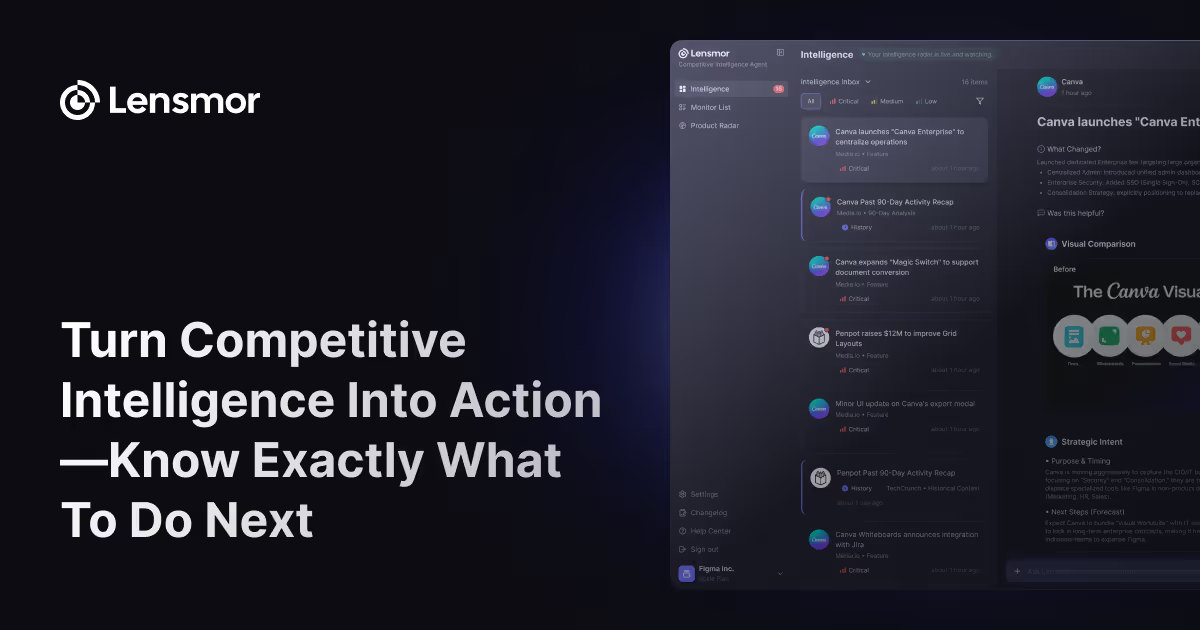
Stop copying features. Start understanding intent.
We're building Lensmor, the intelligent CI Agent designed to help Growth SaaS companies escape the Feature Parity Trap.
The Old Way: Manual competitor tracking with spreadsheets. Visualping alerts that tell you "Competitor changed their pricing page" with no context. Enterprise tools that cost $50K/year and still just give you feature lists. Result: You waste 40% of your development cycles chasing feature parity.
The New Way with Intent Recognition: Lensmor doesn't just track what competitors do—we reveal why they do it. Our intent recognition engine analyzes competitor moves to uncover strategic reasoning:
- Feature launches: Is this a retention play? Market expansion? Response to user feedback?
- Pricing changes: Are they moving upmarket? Fighting churn? Testing elasticity?
- Messaging shifts: Who are they now targeting? What pain points are they emphasizing?
Key Capabilities:
- Intent Recognition Engine: Understand the strategic reasoning behind competitor moves
- Signal, Not Noise: Actionable insights filtered from meaningless changes
- Necessary Condition Mapping: Identify which success conditions your competitors are meeting—so you can match them strategically, not blindly
Data Point: Early Lensmor users report saving 12+ hours per week on competitor research and reducing wasted feature development by 35%.
🔥 Limited Time Pre-Launch Offer:
Don't miss out! Join our Waitlist now to secure 50% OFF your subscription and get a Free Backlink when we go live.
Conclusion: Stack the Conditions, Skip the Feature Checklist
Stop looking for a feature checklist to copy. Stop calling success stories "Rearview Mirror" scams just because copying their features didn't work.
The founders who win aren't the ones who achieved feature parity. They are the ones who understood that Startup Success is a Multivariate Equation—and features are just one variable.
You need to:
- Solve a real problem (Necessary).
- Create viral loops (Necessary).
- Iterate relentlessly (Necessary).
- Simplify radically (Necessary).
- Target narrowly (Necessary).
If you do all 5, success is not guaranteed—remember, there are no sufficient conditions—but your probability of success skyrockets from 0.01% to 50%. And in the startup world, those are odds worth fighting for.
The question isn't whether your competitor has a feature you don't. The question is: why did they build it, and do your users actually need it? Use intent recognition to find out what successful competitors are doing right, then stack the conditions methodically.
Build something people LOVE—not a feature checklist nobody asked for.
Frequently Asked Questions (FAQs)
Q: Is copying a competitor feature ever a good idea?
A: Copying features is useless without understanding the intent. You can copy a UI (Necessary Condition: Good Design), but you can't copy the trust, data, and user research that made the UI work. Copying is only useful if you understand why the feature exists and confirm your users have the same need. The goal of competitive intelligence isn't to copy—it's to understand.
Q: How do I know if I have a "Necessary Condition"?
A: Ask yourself: "Can I succeed without this?" If the answer is "No," it's a necessary condition. (e.g., You can succeed without dark mode, but you cannot succeed without solving a real problem).
Q: What is the most important condition for startup success?
A: Solving a real problem for a specific group of people. This is product-market fit in its purest form. Without this foundation, no amount of features, design, or funding will save you. This is the bedrock of all other conditions.
Q: How do I escape the Feature Parity Trap?
A: Use intent recognition instead of feature tracking. When you see a competitor launch something, don't ask "Should we build this?" Ask "Why did they build this? What problem are they solving? Do our users have that problem?" Tools like Lensmor automate this strategic analysis.
Q: How can intent recognition help me build better products?
A: By revealing the strategic reasoning behind competitor moves, you can make informed decisions instead of reactive ones. For example, if Lensmor's intent recognition reveals a competitor's new feature is a retention play for enterprise users, and you're targeting SMBs, you know to skip it.
Q: How many Necessary Conditions do I need to meet for startup success?
A: There's no magic number—it depends on your market. But here's the data: Lensmor's analysis of 500+ startups shows that meeting 4+ of the 5 pillars described here correlates with a 12x higher chance of reaching $1M ARR. Missing even one pillar drops your odds significantly—no matter how many features you ship.