

Hook: There's a specific kind of silence that haunts founders. It's the silence of a Product Hunt launch that gets 12 upvotes—when you spent months building, hyped yourself up for "launch day," and then... crickets. Here's the brutal truth: Most founders treat PH as a marketing channel to get users. This is fatal. The founders who dominate Product Hunt treat it as a multiplier for the traction they've already built.
The paradox? We have more launch tools than ever, yet 85% of PH launches fail because founders build in a vacuum. To win on launch day, you don't need a bigger budget. You need better Competitive Intelligence and a battle-tested playbook.
TL;DR: Your Product Hunt Launch shouldn't be a gamble—it should be a calculated victory. After analyzing 1000+ launches, we've found that the winners don't just "launch"—they execute a military-grade strategy. This playbook reveals how to use reverse-engineered Competitor Analysis to find a winning angle, validate your MVP with a CAC under $4, build a 100-user launch army, and crush the leaderboards on launch day.
The Old Way: Why Most Product Hunt Launches Fail
Let's be brutally honest about why most launches flop. The typical "Spray and Pray" approach looks like this:
- Launching a raw MVP without proving anyone actually wants it
- Zero community warmup—asking strangers for favors on launch day
- Copying competitors without a sharp, differentiating angle
- Obsessing over vanity metrics (views) instead of conversions
- Buying votes or spamming DMs (the fastest way to get flagged)
Lensmor data shows that 85% of failed launches skipped the pre-launch validation phase. They tried to build the plane while flying it.
You can't afford to guess. You need a protocol.
The Lensmor Playbook: 5 Phases to Crushing Your Launch
This isn't just about "growth"—it's about orchestrating a perfect storm on launch day. Here's the framework that's working for winning founders.
Phase 1: Know Your Battlefield (Competitive Positioning)
You can't win on Product Hunt if you're just "another tool." You need a wedge—a sharp positioning angle that makes voters think, "Finally, someone gets it."
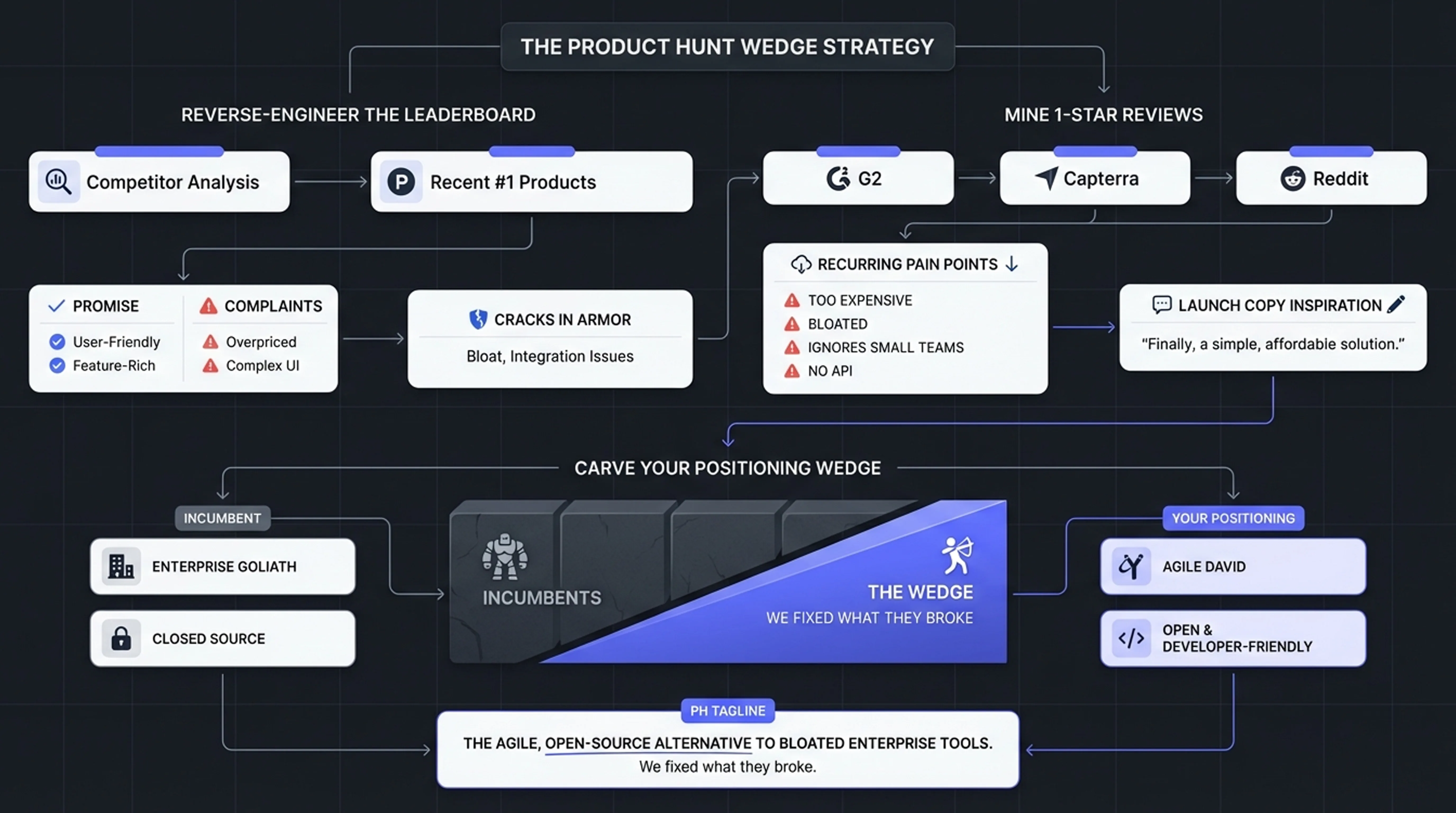
Reverse-Engineer the Leaderboard: Don't ask "What should I build?" Ask "What are the top players doing wrong?" Use Competitor Analysis to find the cracks in their armor. Study recent #1 products in your category—what did they promise? What complaints appeared in the comments? For real-world examples, see 7 Real-World Competitive Intelligence Examples.
Mine the 1-Star Reviews: Go to G2, Capterra, and Reddit. Find the incumbents. Look for recurring pain points: "Too expensive," "Bloated," "Ignores small teams," "No API." These complaints become your launch copy. Use 10 Best Market Intelligence Software Tools to map the competitive landscape.
Carve Your Positioning Wedge: If the incumbent is an Enterprise Goliath, you're the Agile David. If they're Closed Source, you're Open and Developer-Friendly. Your PH tagline should scream "We fixed what they broke."
Phase 2: Build Your Launch Army (First 100 Users)
Here's the secret: You need 100 people ready to upvote, comment, and share the second you go live. This is your "Launch Army"—and you can't build it overnight.
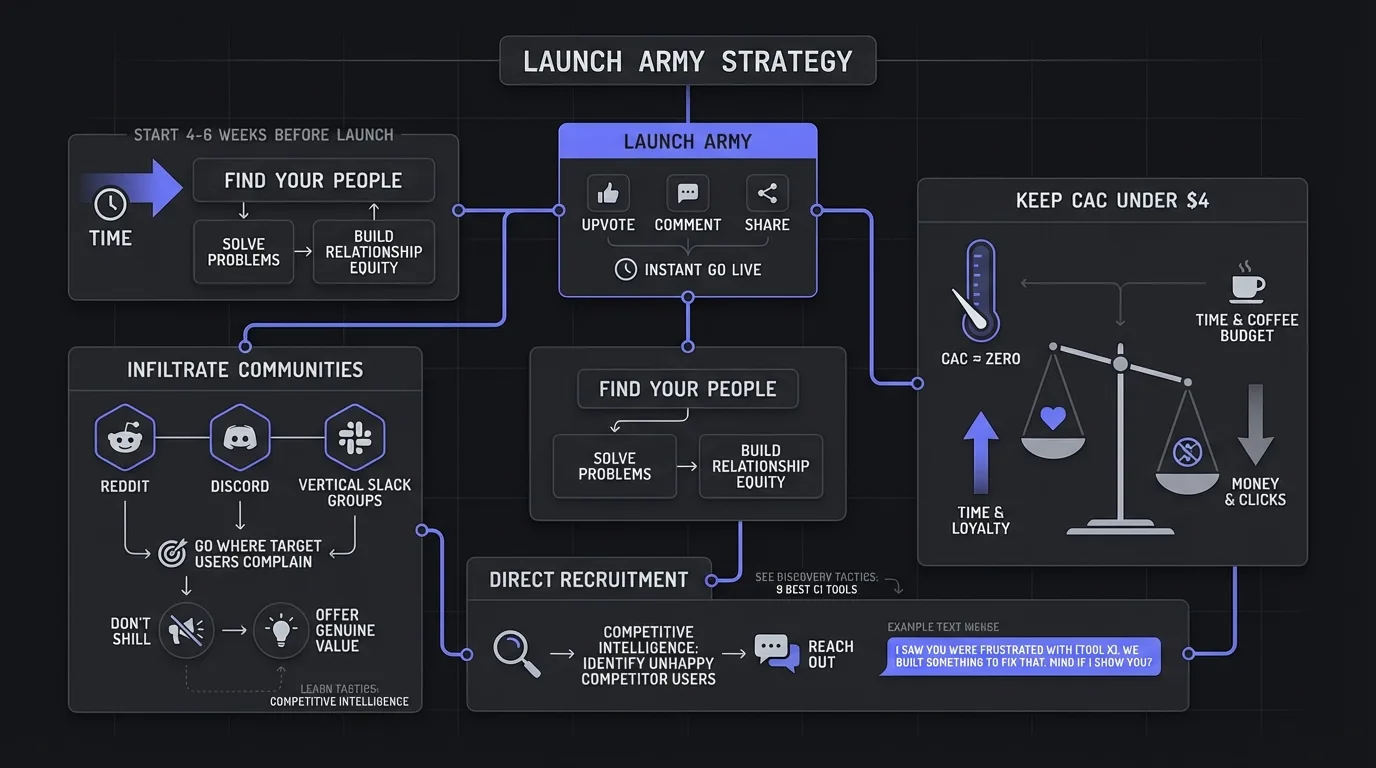
Start 4-6 Weeks Before Launch: You need time to find your people, solve their problems, and build enough relationship equity that they want to help you win.
Infiltrate Communities: Reddit, Discord, vertical Slack groups—go where your target users complain. Don't shill. Solve their problems. Offer genuine value. Learn the exact tactics in How to Gather Competitive Intelligence for SaaS.
Direct Recruitment: Use Competitive Intelligence to identify users of your competitors who are publicly unhappy. Reach out: "I saw you were frustrated with [Tool X]. We built something specifically to fix that. Mind if I show you?" See 9 Best Competitive Intelligence Tools for SaaS for discovery tactics.
Keep CAC Under $4: In this phase, you're trading time for loyalty, not money for clicks. Your CAC should be near zero—just your time and coffee budget.
Phase 3: Validate Your Ammunition (Metrics)
Don't launch a leaky bucket. Before you set a date, your dashboard needs to prove you're ready.
The "Go/No-Go" Checklist:
- Registration-to-Paid Conversion: Is it above 5% (SMB) or 10% (B2B)?
- Day 2 Retention: Did they come back?
- Referral Signal: Did anyone tell a friend unprompted?
- "Disappointed" Test: If you asked your users "How would you feel if this product disappeared tomorrow?" would they say "Very disappointed"?
If your numbers aren't there, delay the launch. A failed PH launch is worse than no launch. Reference The Ultimate Competitor Intelligence Framework for setting up your tracking.
Phase 4: Create Evangelists (Founder-Led Hype)
Product Hunt's algorithm rewards velocity, but humans drive the algorithm. You need evangelists—not just users, but believers.
Founder-Led Interviews: Personally talk to your top 30 users. Ask them: "If we launched on Product Hunt next Tuesday, would you support us?" Get a verbal "Yes." Make them feel like they built the product: "We added that feature you requested—it's in the launch version."
Co-Creation Mindset: Share sneak peeks. Ask for feedback on your PH copy and video. Make them stakeholders in your success. For a case study on this user-centric approach, read How to Do Competitive Analysis for AI SaaS.
The Pre-Launch Email: 24 hours before launch, send your army a heartfelt email. Not a cold ask—a story. "We built this because we were frustrated by [Problem]. You helped us make it real. Tomorrow, we're launching. Your support would mean everything."
Phase 5: Execute the Launch (The Main Event)
This is it. The culmination of your preparation. Launch day is a war room, not a celebration.
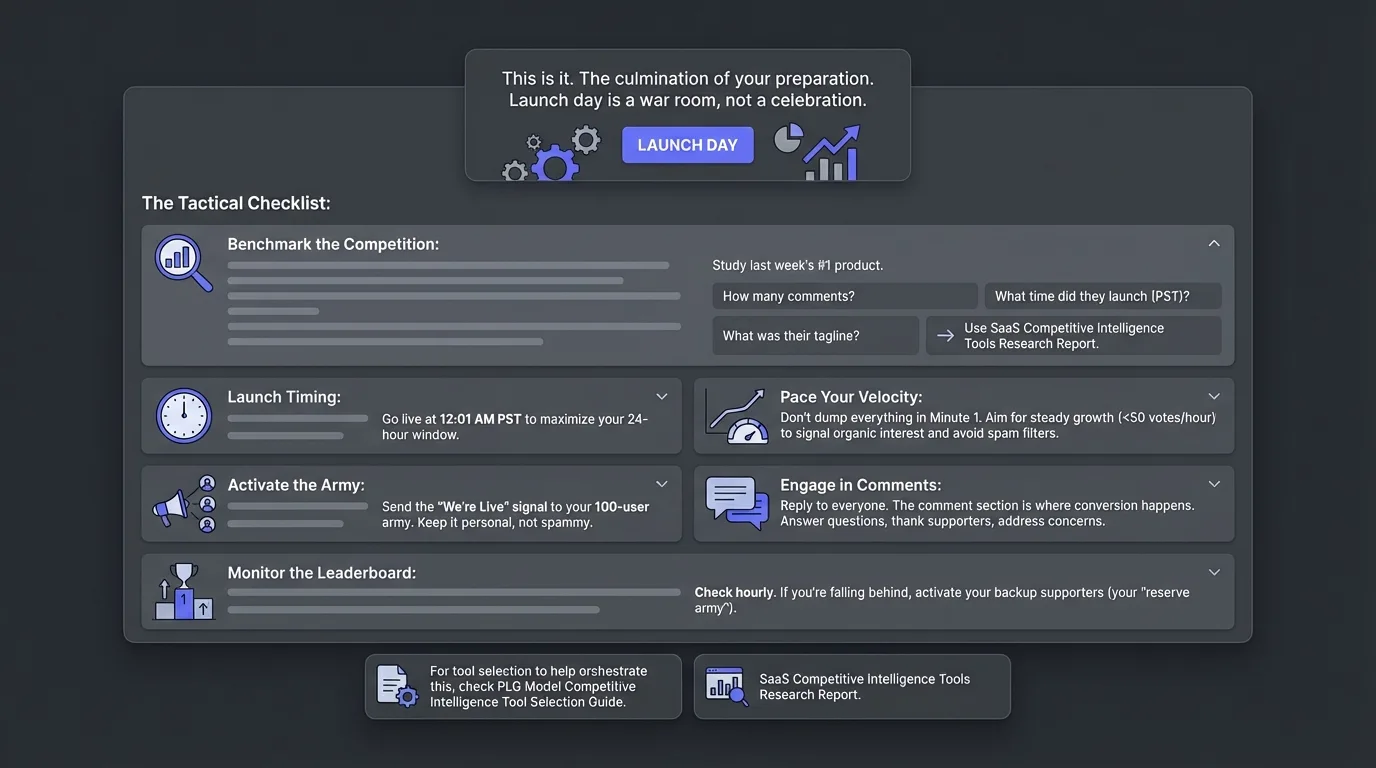
The Tactical Checklist:
- Benchmark the Competition: Study last week's #1 product. How many comments? What was their tagline? What time did they launch (PST)? Use SaaS Competitive Intelligence Tools Research Report.
- Launch Timing: Go live at 12:01 AM PST to maximize your 24-hour window.
- Activate the Army: Send the "We're Live" signal to your 100-user army. Keep it personal, not spammy.
- Pace Your Velocity: Don't dump everything in Minute 1. Aim for steady growth (<50 votes/hour) to signal organic interest and avoid spam filters.
- Engage in Comments: Reply to everyone. The comment section is where conversion happens. Answer questions, thank supporters, address concerns.
- Monitor the Leaderboard: Check hourly. If you're falling behind, activate your backup supporters (your "reserve army").
For tool selection to help orchestrate this, check PLG Model Competitive Intelligence Tool Selection Guide.
Post-Launch: The Real Work Begins
Congratulations—you survived launch day. But a #1 badge doesn't pay the bills. Here's what winners do next:
- Analyze the Data: Who signed up? What was their source? Who churned? Compare your stats to industry benchmarks using Competitive Intelligence.
- Follow Up with Every Signup: Personally email or message every new user. "Thanks for trying us out. What problem were you hoping we'd solve?"
- Stay Humble: The launch is just the starting line. The founders who sustain growth treat PH as validation, not victory.
- Tool Stack for Post-Launch Growth:
- Competitive Intelligence: Lensmor (for tracking competitors post-launch)
- Influencer Outreach: Easy KOL, Eezycollab
- Meeting Notes: Otter.ai or Fathom
🚀 Stop Launching Blind. Start Winning.
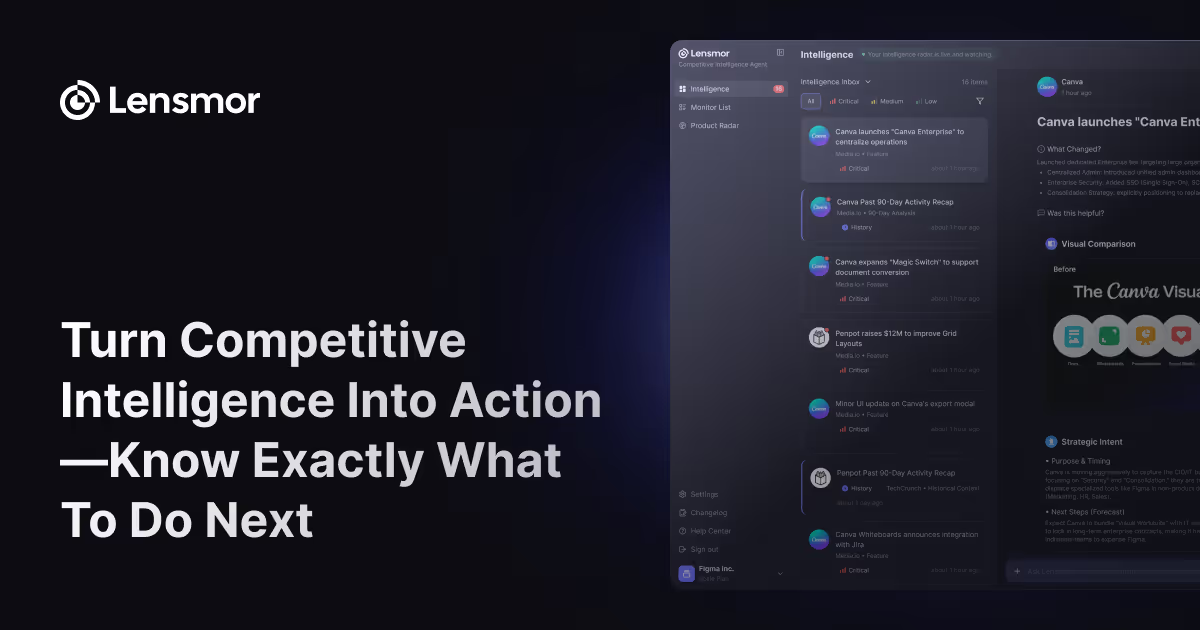
You can guess what your competitors are doing, or you can know. We're building Lensmor—the intelligent Competitive Intelligence agent for founders who want to crush their market, not just participate in it.
Lensmor automates the competitive tracking and delivers the strategic insights you need to outmaneuver giants—without the $500+/month enterprise price tag.
🔥 Limited Pre-Launch Offer:Join the Waitlist now to secure 50% OFF your subscription and get a Free Backlink when we go live.
Conclusion
Product Hunt Launch success isn't luck—it's a sequence of correct decisions. By treating your launch as a strategic campaign driven by Competitor Analysis, MVP Validation, and a well-built launch army, you stop gambling and start dominating.
The founders winning today didn't outspend anyone. They outsmarted the competition with better intelligence, tighter execution, and a community that believed in them.
Remember: The goal isn't just to launch. The goal is to win.
Frequently Asked Questions
Q: How many upvotes do I need to reach #1 on Product Hunt?
It varies by day, but typically you need 400-600 genuine upvotes to crack the top 3 on a competitive day (Tuesday-Thursday). However, velocity and comment engagement matter more than raw vote count. A product with 300 votes and 50 thoughtful comments often beats one with 500 silent votes. Product Hunt's algorithm rewards sustained momentum over sudden spikes.
Q: Should I use a Hunter or launch it myself?
In 2025, the "Super Hunter" effect has diminished significantly. While a top Hunter can give you a small initial visibility boost, launching it yourself (as the maker) builds more authentic connection with the community. The most successful recent launches were self-posted with heartfelt founder stories. Save the Hunter relationship for a potential re-launch or major update down the road.
Q: How long before launch should I start building my "Launch Army"?
Start at least 4-6 weeks out—minimum. You need time to find your ideal users, solve their problems authentically, and build enough relationship equity that they want to help you win. Trying to build a community 3 days before launch is a recipe for failure. The best PH performers spent 2-3 months building genuine relationships before asking for support.
Q: Is paid advertising worth it for a Product Hunt launch?
Generally, no. Product Hunt's community values organic discovery and can smell paid traffic from a mile away. Paid traffic rarely converts to upvotes and can actually trigger spam filters. Instead, spend that budget on high-quality launch assets (professional video, custom graphics) or improved onboarding for the organic traffic you do get. Your ROI will be 10x better.
Q: What if my launch flops? Can I re-launch?
A failed launch isn't a failed company—it's data. If your launch underperforms, analyze ruthlessly: Was your positioning weak? Did you launch too early? Was your "army" too small? Product Hunt technically allows re-launches for major version updates (e.g., v2.0), but wait at least 6 months and make sure you've genuinely evolved the product. Use Competitive Intelligence to study what the recent winners did differently, iterate your product and strategy, and come back stronger. For a deeper understanding of avoiding common pitfalls, read Why Copying Competitors Will Kill Your Startup: The 'Feature Parity' Trap.